Showing posts with label humanities. Show all posts
Showing posts with label humanities. Show all posts
Monday, July 18, 2011

Wednesday, July 13, 2011
shocking art ( for my humanities students)
WARNING: NUDITY AND VIOLENT SCENES
YOU MAY WATCH OTHER PARTS AT YOUTUBE.COM
YOU MAY WATCH OTHER PARTS AT YOUTUBE.COM
Monday, July 11, 2011
Saturday, July 2, 2011
Sunday, June 26, 2011
humanities and arts
Yoko ono'performance art
James Franco
garlic Painting
UV painting
dance
choir rosas pandan (russian boys choir)
matrix pingpong
Philippine Art (ms powerpoint)
Just Pictures 100 Girls
Introduction to Japanese Horror Film - Colette Balmain
Como dibujar comics (Manga)
Manga Anime History and Influence
Thursday, October 15, 2009
Thursday, September 17, 2009

Saturday, September 12, 2009
Monday, August 17, 2009
mindgames
just watched this film in egai sai in UP. it was fun. :) but as expected japanese films can go over the top, but in such a nice and artistic way.
mindgames
mindgames
Saturday, August 15, 2009
tata nano

how is this for a real cheap car? only $2,000 dollars ( convert to philippine peso around 100,000). even some imac books are more expensive than this.
Friday, July 31, 2009

Thursday, July 23, 2009
submission by theo van gogh
this is an interesting video made by theo van gogh regarding violence against women in islam. unfortunately, theo van gogh, the director, was shot by a religious fanatic. this is an interesting video for discussion on cultural relativism vis-a-vis universal rights, particularly pertaining to women's rights.
artists as revolutionaries
artists are citizens of this country. in fact, artists are often revolutionaries in their own right.
to celebrate the last SONA of GMA i am posting these videos
to celebrate the last SONA of GMA i am posting these videos
Monday, July 20, 2009
renaissance art
The Italian Renaissance was one of the most productive periods in the history of art, with large numbers of outstanding masters to be found in many centers and in all the major fields painting, sculpture, and architecture. In Florence, in the first half of the fifteenth century, there were great innovators in all these fields, whose work marked a beginning of a new era in the history of art. These innovators included Masaccio in painting, Brunelleschi in architecture, and Donatello in sculpture. Their new ideals and methods were systematized in the theoretical writings of their friend and fellow artist Leon Battista Alberti. There can also be observed in this period a change in the social status of the artist. Heretofore, he had been an artisan, a craftsman. Now the attempt was made to include artists among the practitioners of the "liberal arts," which were regarded as being on a higher level than the "mechanical arts." These efforts bore fruit, and some of the great masters, for example, Titian and Michelangelo, by the force of their genius and personality, were able to achieve a measure of status and respect rarely enjoyed by their predecessors. The idea of artistic genius became popular; Michelangelo was called "divine" because of the greatness of his creative powers.
In the Renaissance, art and science were closely connected. Both the artist and the scientist strove for the mastery of the physical world, and the art of painting profited by two fields of study that may be called scientific: anatomy, which made possible a more accurate representation of the human body, and mathematical perspective. Perspective in painting is the rendering on a two- dimensional surface of the illusion of three dimensions. Previous painters had achieved this effect by empirical means, but the discovery of a mathematical method of attaining a three-dimensional impression is attributed to Brunelleschi in about 1420. Henceforth, the method could be systematically studied and explained, and it became one of the chief instruments of artists, especially painters, in their pursuit of reality. Some men were both artists and scientists, notably Leonardo da Vinci and Piero della Francesca. It is doubtful whether they would have understood our distinction between art and science.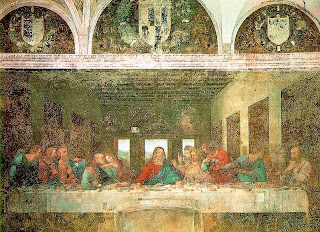

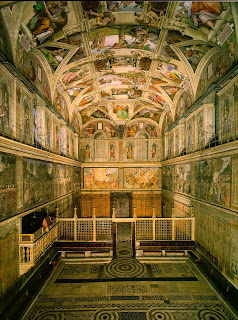
In the Renaissance, art and science were closely connected. Both the artist and the scientist strove for the mastery of the physical world, and the art of painting profited by two fields of study that may be called scientific: anatomy, which made possible a more accurate representation of the human body, and mathematical perspective. Perspective in painting is the rendering on a two- dimensional surface of the illusion of three dimensions. Previous painters had achieved this effect by empirical means, but the discovery of a mathematical method of attaining a three-dimensional impression is attributed to Brunelleschi in about 1420. Henceforth, the method could be systematically studied and explained, and it became one of the chief instruments of artists, especially painters, in their pursuit of reality. Some men were both artists and scientists, notably Leonardo da Vinci and Piero della Francesca. It is doubtful whether they would have understood our distinction between art and science.


Sunday, July 19, 2009
Saturday, July 18, 2009
The 10 Most Expensive Paintings Ever Sold
* $140 million for No. 5, 1948 by Jackson Pollock (2006)
* $137.5 million for Woman III by Willem de Kooning (2006)
* $135 million for Adele Bloch-Bauer I by Gustav Klimt (2006)
* $104 million for Boy with a Pipe by Pablo Picasso (2004)
* $95.2 million for Dora Maar with Cat by Pablo Picasso (2006)
* $82.5 million for Portrait du Dr. Gachet by Vincent van Gogh (1990)
* $78.1 million for Au Moulin de la Galette by Pierre-Auguste Renoir (1990)
* $76.7 million for The Massacre of the Innocents by Paul Rubens (2002)
* $71.5 million for Portrait de L'Artiste sans Barbe by Vincent van Gogh (1998)
* $60.5 million for Rideau, Cruchon et Compotier by Paul Cézanne (1999)
Subscribe to:
Posts (Atom)